GCSE maths revision & step-by-step help
Maths Vault’s student hub is a free set of GCSE and KS3 calculators and practice tools that show full UK-method working in the browser. No account is required. Methods match AQA, Edexcel and OCR-style classroom practice (for example y = mx + c). The steps are algorithmic, not chatbot answers.
Part of Maths Vault, a UK secondary maths platform. Teachers use a separate signed-in area for worksheet generation and Vault Viewer.
GCSE revision flashcards
Free flashcard sets by topic for Foundation and Higher. Tap to flip.
Try GCSE revision flashcards →How to Use Pythagoras' Theorem: A Step-by-Step GCSE Maths Guide
How to Use Pythagoras' Theorem: A Step-by-Step GCSE Maths Guide
Pythagoras' theorem is one of the most famous and useful rules in all of mathematics. If you're studying for your GCSE maths exam (with AQA, Edexcel, or OCR), you must know how to apply it. This guide will walk you through everything you need to know, from the basic rule to tackling trickier problems.
What is Pythagoras' Theorem?
Pythagoras' theorem applies only to right-angled triangles. A right-angled triangle has one angle of 90°, marked with a small square.
The theorem states:
> In a right-angled triangle, the square of the length of the hypotenuse is equal to the sum of the squares of the lengths of the other two sides.
Let's break down that statement:
Hypotenuse: The longest side of the triangle, which is always opposite the right angle.
The other two sides: Often called the adjacent and opposite sides relative to a given angle, but for Pythagoras, we just call them the two shorter sides.
The Formula
The theorem is written as the famous formula:
a² + b² = c²
Where:
c is the length of the hypotenuse.
a and b are the lengths of the other two sides.
flowchart TD
A[Identify the Right-Angled Triangle] --> B{What side are you finding?}
B --> C[The Hypotenuse (c)]
B --> D[One of the shorter sides (a or b)]
C --> E[Use formula: c = √(a² + b²)]
D --> F[Use formula: a = √(c² - b²)]
E --> G[Square, Add, Square Root]
F --> H[Square, Subtract, Square Root]
G --> I[State final answer with units]
H --> I
Step-by-Step: Finding the Hypotenuse (Longest Side)
This is the most common type of question. You are given the two shorter sides and need to find c.
Example 1: A right-angled triangle has shorter sides of 6 cm and 8 cm. Find the length of the hypotenuse.
Label the sides. a = 6, b = 8, c = ?
Write down the formula: a² + b² = c²
Substitute the known values: 6² + 8² = c²
Calculate the squares: 36 + 64 = c²
Add: 100 = c²
Solve for c by square rooting: c = √100
Calculate: c = 10
State the answer with units: The hypotenuse is 10 cm.
Step-by-Step: Finding a Shorter Side
Sometimes the question gives you the hypotenuse and one shorter side, asking you to find the other shorter side.
Example 2: A ladder 5 m long leans against a wall. The foot of the ladder is 1.2 m from the wall. How far up the wall does the ladder reach? (This forms a right-angled triangle with the hypotenuse as the ladder).
Label the sides. Hypotenuse, c = 5. One shorter side, a = 1.2. The unknown side is the other shorter side, b = ?.
Write down the formula: a² + b² = c²
Substitute the known values: 1.2² + b² = 5²
Calculate the squares: 1.44 + b² = 25
Rearrange to isolate b²: b² = 25 - 1.44
Subtract: b² = 23.56
Solve for b by square rooting: b = √23.56
Calculate (using your calculator): b ≈ 4.8539...
Round appropriately and state the answer with units: The ladder reaches approximately 4.85 m up the wall.
Key Skills and Common Pitfalls
Using Your Calculator Correctly
When finding a shorter side, the order of operations is crucial. For Example 2, to calculate b = √(5² - 1.2²) on your calculator, you must either:
Type: √(5² - 1.2²) or
Type: 5² - 1.2² = and then press the square root button.
Never do √5² - √1.2² – this is wrong!
Leaving Your Answer in Exact Form (Surds)
For the Higher GCSE paper, you may be asked to leave your answer as a surd (an exact square root).
Example 3: Find the hypotenuse of a triangle with shorter sides 2 cm and 7 cm.
2² + 7² = c²
4 + 49 = c²
53 = c²
c = √53
The exact answer is √53 cm. You would only convert this to a decimal if the question asks for a rounded answer.
Is it a Right-Angled Triangle?
You can also use Pythagoras' theorem in reverse to check if a triangle is right-angled. If a² + b² = c² is true for the three sides (with c as the longest), then the triangle is right-angled. If it's false, it isn't.
Example 4: Is a triangle with sides 5 cm, 7 cm, and 9 cm right-angled?
Longest side is 9 cm, so this is c.
Check:
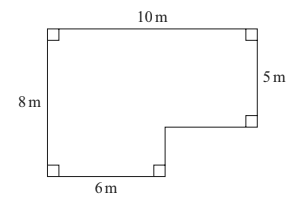
(a) Does Petra have enough paint to cover the floor? You must show all your working.
(b) It is later found that 1 litre of paint actually covers 11 m² of floor. Does this affect your answer to part (a)? Give a reason for your answer.
Start with today’s featured resource above, have a go at the exam question of the day, then explore the tools below. Practise with real data in free football maths and themed maths quizzes. Everything on this hub is free, works in your browser, and shows full step-by-step working.
More tools
-
Signed-off single-topic booklets
Download practice booklets that have been checked and signed off. Includes a preview link and an answers link, plus a download count for each booklet.
-
Surd calculator
Simplify surds like √50 and rationalise denominators — step-by-step GCSE working.
-
Sine & cosine rule
Find missing sides and angles in any triangle — step-by-step Higher GCSE working.
-
Completing the square
Convert a quadratic to completed-square form and find the turning point with full working.
-
Inequalities calculator
Solve linear inequalities like 3x + 5 < 14 with step-by-step working.
-
Vectors calculator
Add, subtract, scalar multiply column vectors and find magnitude — every step shown.
-
Iteration calculator
Apply x_{n+1} = ax + b or fractional iteration formulas from a starting value.
-
Probability tree lab
Multi-trial probability trees — coins, dice and bags — with or without replacement, plus experiments and Venn diagrams.
-
Transformations explorer
Reflect, translate, rotate and enlarge a shape on a coordinate grid — object and image shown.
-
Rubik's cube
Drag a 3D cube like the real puzzle. Only whole-layer turns are allowed, so every position is physically possible.
-
Circle theorems explorer
Interactive diagrams and explanations for key GCSE circle theorems (Higher).
-
Histogram builder
Enter class intervals and frequencies — draw a histogram with frequency density bars.
-
Pie charts
Build and draw pie charts, complete missing angles or frequencies, interpret charts and compare two groups.
-
Casio calculator skills
Button sequences for standard form, tables, statistics and trigonometry on GCSE calculators.
-
Quadratic equation solver
Solve ax² + bx + c = 0 by factorising when possible, or the quadratic formula — full step-by-step GCSE working.
-
Expand & factorise expressions
Expand single brackets like 3(x + 4) or factorise by taking out a common factor — every step explained.
-
Volume & surface area
Cuboids, cylinders, triangular prisms and cones — work out volume or surface area with step-by-step formulas.
-
Pythagoras calculator
Find the hypotenuse or a shorter side using a² + b² = c² — labelled triangle diagram and every step explained.
-
Trigonometry calculator
SOH CAH TOA for right-angled triangles: find a missing side or angle with a labelled diagram and step-by-step working.
-
Linear graph explorer
Gradient, midpoint and the equation y = mx + c from two points — or plot from m and c, with a graph and full working.
-
Fraction calculator
Simplify fractions, add, subtract, multiply and divide, or convert between fractions, decimals and percentages — every step shown.
-
Circle calculator
Circumference, area, and finding the radius from C or A — step-by-step using π.
-
Compound measures
Speed = distance ÷ time and density = mass ÷ volume. Enter two values to find the third with full working.
-
Averages calculator
Paste a list of numbers to get mean, median, mode and range with step-by-step GCSE working.
-
Percentage calculator
Find a percentage of an amount, work out increases and decreases, reverse percentages, and percentage change — every step shown.
-
Ratio calculator
Simplify ratios, share a total in a given ratio, and solve missing-share problems with full step-by-step working.
-
Expand brackets
Type in two brackets like
(x+6)(x+7)and get a full walkthrough with the FOIL method and grid method. No more guessing—see every step. -
Factorise quadratics
Stuck factorising? Enter your quadratic (e.g.
x²+13x+42) and we’ll show you step-by-step how to factorise it—or use completing the square if it doesn’t factorise nicely. -
Quadratic graph features
Enter a quadratic (e.g.
x²−4x+3) and use completing the square to find the turning point, y-intercept and x-intercepts, with a labelled graph. -
Nth term finder
Got a sequence (or a term-to-term rule)? Paste in your numbers or your nth term and we’ll work out the formula step by step, find the 67th term, and tell you if a number is in the sequence.
-
Number Explorer
Explore any number: place value, prime factors, divisors, sum of digits, Roman numerals, binary and more. Handy for number facts and “number of the day” style practice.
-
Area and perimeter calculator
Choose a shape (square, rectangle, triangle, trapezium, circle, L-shape), add dimensions, and get step-by-step area and perimeter—or find a missing side from a given area or perimeter.
-
Standard form calculator
Convert to and from standard form, and add, subtract, multiply and divide with step-by-step working. Covers same and different powers of 10.
-
Simultaneous equations solver
Solve two linear equations, or a line with a circle (
x² + y² = …) or parabola, with exact answers and step-by-step elimination or substitution working. -
Currency converter
Live exchange rates (ECB) or enter your own rate. Convert between GBP, USD, EUR and 30+ currencies—useful for real-world maths and problem-solving.
-
Symmetry mirror
Upload an image or diagram, then place and rotate a virtual mirror to find lines of symmetry. See the reflection in real time—great for symmetry topics.
-
Maths whiteboard
Ruler, protractor, a compass that works like a real compass, and usable tracing paper. Draw constructions and diagrams—no sign-up.
-
Today's Keystones
Five daily GCSE retrieval questions — choose Bedrock, Cornerstone, Lintel or Capstone. One from each strand. Today's set only. Free, no sign-up.
-
GCSE revision flashcards
Free flashcard sets by topic for Foundation and Higher: Number, Algebra, Ratio, Geometry, Statistics & probability. Tap to flip—read-only, no sign-up.
-
Pi search
View the first 1 to 1,000,000 digits of pi, then search for any number—your birthday, 314 for Pi Day (March 14), or any digit sequence. We highlight matches and show positions. Great for Pi Day activities.
-
Maths in the news
Filter by topic—national, global, politics, environment, sport, local—from many UK RSS sources. Stories are scored for statistics and mathematical hooks. No sign-up.
-
World Cup 2026
Your fan hub for FIFA World Cup 2026 — today’s matches, group tables, latest results, headlines and top scorers. There’s also a free maths quiz built on live tournament data. No sign-up.
-
Themed maths quizzes
Free GCSE maths quizzes built around topics pupils care about — GCSE leavers, UK weather, esports, music, Pokémon TCG and more. Data-driven multiple-choice questions; members can download printable worksheets and PDFs.
-
Football maths quiz & worksheet
Free maths quiz and printable worksheet using real Premier League and Championship league table data. Practise points, goal difference, averages and percentages with live standings—do the quiz online or download a PDF worksheet. No sign-up.
-
GCSE Maths Blog
Step-by-step walkthroughs of common topics and exam-style questions. Diagrams, worked examples and revision-friendly posts—free to read.
Common questions
Do I need to sign up?
No. The calculators, Keystones, quizzes and blog walkthroughs on this page work in your browser with no account.
Which exam boards are these for?
UK-method working used on AQA, Edexcel and OCR GCSE Mathematics (for example y = mx + c and SOH CAH TOA). They are not official exam-board papers.
Is this AI?
No. These student tools show algorithmic working: programmed steps, not chatbot answers.
Is it free?
Yes for this student hub. Teacher worksheet generators on Maths Vault are a separate signed-in product with a free tier and paid plans.